
 日本語
 Русский
 España
 عرب .

Reflective Insulation Membrane: Aluminum Film, Reinforcement and Thermal Performance
2026-11-27
A 12 micron aluminum film on a 60 gsm nonwoven can look identical in a sample book to a metallized film on a 35 gsm scrim. The difference appears in service: one stays reflective across a ventilated cavity, while the other scratches, creases or collects condensation on the wrong face. The specification that matters is not the silver colour of the roll. It is the emittance of the surface, the air space it faces and the reinforcement that keeps that surface continuous.
Working definition: a reflective insulation membrane is a low-emittance sheet, usually aluminum foil or metallized film bonded to a woven, nonwoven or scrim carrier, that reduces radiant heat transfer across an adjacent air space. It may also act as a vapour control layer, but only when the product construction and joints are specified for that duty.
Why the aluminum film is not the insulation by itself
The aluminum film is a low-emittance boundary, not a bulk insulator. Its thermal effect comes from suppressing radiation across an air space; without that space, the benefit collapses. A reflective membrane placed tight against a solid surface has little chance to change radiant exchange because the low-emittance face is no longer looking into a cavity.
Emissivity is the fraction of radiant energy a surface emits compared with a blackbody at the same temperature. For opaque surfaces in the infrared band, reflectivity is the practical complement. Clean aluminum usually sits at about 0.03 to 0.05 emittance in design tables. Metallized films commonly fall around 0.05 to 0.10, depending on coating thickness and substrate. Dust, grease, oxidation and handling marks all push emittance upward, and that is why a clean foil surface and a contaminated foil surface are not the same product in service.
RIMA International's handbook on reflective insulation and radiant barriers reports that foil and metallized surfaces can cut radiant heat transfer by as much as 97 per cent compared with a high-emittance surface, provided the air space and geometry are suitable. That number is a radiant-exchange figure, not a whole-assembly R-value. It does not remove the need for bulk insulation, airtightness or condensation control.
Film and carrier choices: what changes on site
Film type controls surface emittance; reinforcement controls damage tolerance and installation quality. A foil faced woven carrier and a metallized nonwoven are not interchangeable even when both are described as reflective. The construction decides how the membrane handles fasteners, abrasion, lap sealing and the local geometry around purlins, studs and service penetrations.
| Construction | Reflective layer | Carrier | Vapour control | Typical fit | Main risk |
| Aluminum foil with scrim | 6 to 12 micron foil | Glass or PET scrim | Low to medium | Roof underlay, open cavity | Creasing and foil cracking |
| Foil with woven carrier | 7 to 20 micron foil | Woven PP or PE | Medium to high | Walls, metal buildings, industrial liners | Abrasion at fasteners |
| Foil with nonwoven carrier | 7 to 12 micron foil | PP nonwoven, 40 to 100 gsm | Medium | Metal roof, HVAC, timber frame | Dust and delamination |
| Metallized film with nonwoven | Deposited aluminum | PP nonwoven | Low to medium | Low-cost radiant facing | Scratch and oxidation |
| Multilayer foil with kraft or bubble | Foil plus scrim | Kraft, bubble, nonwoven | Varies by build | Retrofit, ducts, packaging | Fire class and thickness |
Aotelong's reflective vapour barrier range shows the same logic across model codes rather than one generic roll. The reinforced aluminum film APR90 is aimed at projects where the foil needs a carrier to survive handling before the final air space is closed.
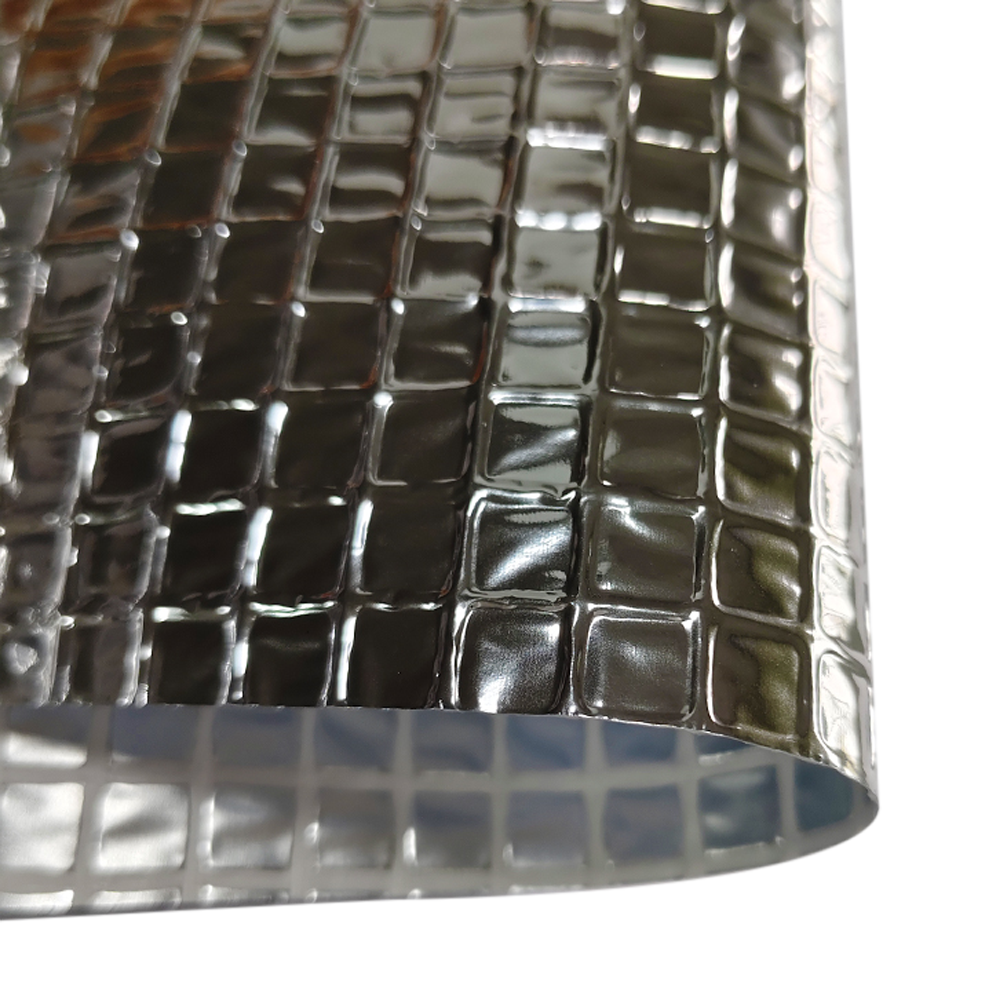 AL APR90 Reinforced Reflective Vapour BarrierThree-layer reflective vapour barrier with PET mesh reinforcement, aimed at roof, wall and floor insulation where handling strength and vapour control matter.View Product →
Reinforcement: the difference between a sample and a serviceable membrane
Reinforcement sets tensile strength, tear resistance, fastener pull-through and jobsite handling. It also determines whether the low-emittance surface remains continuous after installation. A membrane that survives the sample book but fails at the first purlin is not a thermal product; it is a repair item.
Reinforcement adds value when
- A woven carrier is needed for tensile strength and fastener pull-through.
- A nonwoven carrier is needed for conformability and puncture resistance.
- A scrim is needed for dimensional stability at a controlled material cost.
Reinforcement adds risk when
- A heavy carrier reduces conformability around profiled cladding.
- Exposed edges wick water into the laminate instead of shedding it.
- The adhesive system is not compatible with the specified tape or sealant.
A non-woven composite aluminum film such as AN100 trades some tensile stiffness for conformability and a softer hand, which matters around profiled cladding and service penetrations. The correct choice depends on the substrate, the fixing pattern and the air space, not on the thickest carrier available.
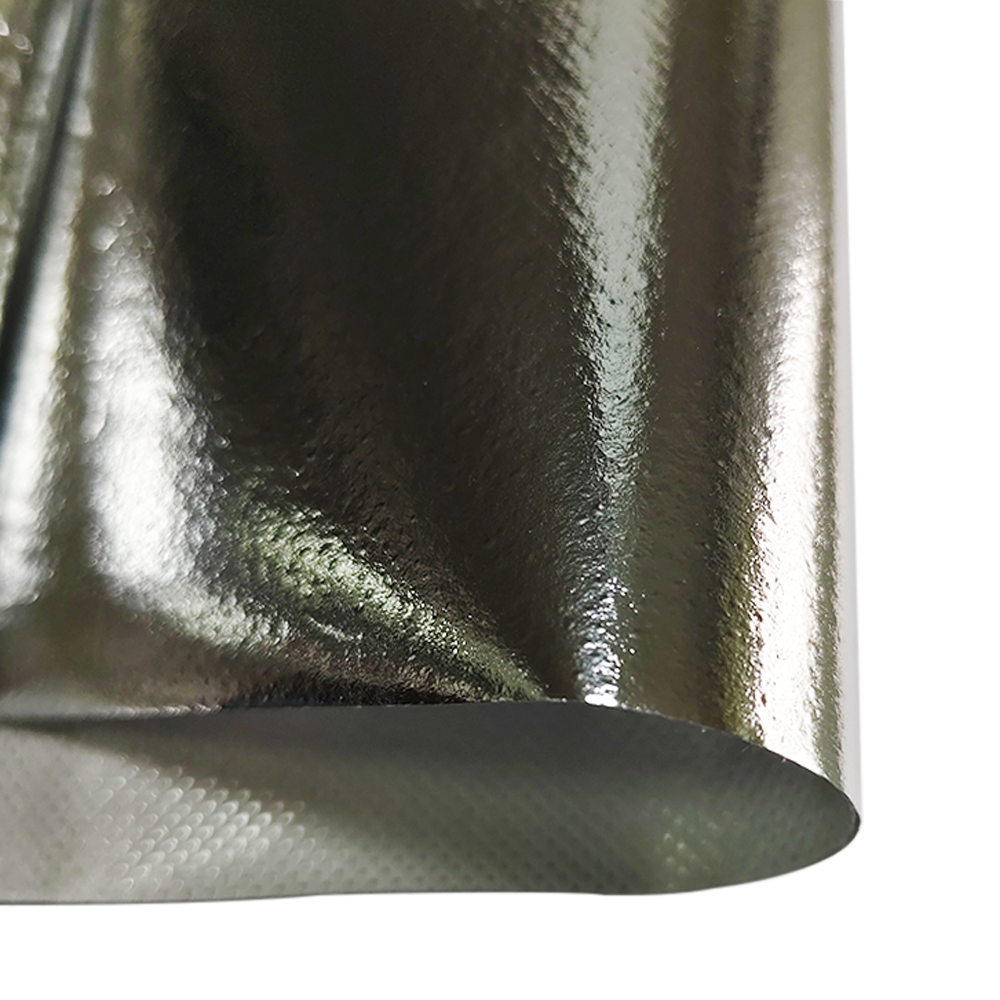 AN100 Al Film PE Nonwoven Composite FabricThree-layer aluminum film, PE and nonwoven composite with flexible backing and moisture resistance for insulation facing, protective packaging and protected building envelope uses.View Product →
Thermal performance belongs to the assembly, not the roll
A reflective membrane does not carry a single R-value. Declared thermal performance applies to a tested assembly with a defined air space, surface emittance, framing, orientation and temperature difference. A datasheet that quotes one number without those boundary conditions is not a specification; it is a marketing line.
ASTM C1224 is the product specification for reflective insulation in building applications, and ASTM C1313 covers sheet radiant barriers for building construction. Both define product requirements; neither replaces an assembly calculation to ISO 6946 or the ASHRAE fundamentals. EN 13984 covers plastic and rubber vapour control layers, including reflective products used as vapour barriers, and it requires declared properties rather than a generic reflective claim.
Check orientation, air-space thickness, ventilation, bounding surface emittance and condensation risk. A 20 mm cavity and a 50 mm cavity can produce different resistance even with the same membrane. Do not accept an R-value copied from a different orientation, a different framing pattern or a different climate condition.
Moisture, dust and installation: the practical derating factors
Condensation, dust and contact with framing can reduce reflective performance more than a small difference in film thickness. A dusty or wet low-emittance surface loses part of its radiant benefit, and a membrane compressed against a solid surface loses its air space. The installation detail is therefore part of the thermal product.
A reflective vapour barrier and a breathable underlay are different products: the first restricts vapour, the second allows it. Reversing them creates interstitial condensation risk. The site's overview of different waterproofing types is a useful cross-check when the roof or wall build-up mixes reflective, vapour-control and breathable layers.
Jiangsu Aotelong New Materials Co., Ltd. lists reflective vapour barriers, vapour barriers, waterproof breathable membranes and window tapes as separate building categories. That separation matters because the reflective surface, the vapour-control function and the water-shedding function are not the same requirement. A membrane can be reflective and still be the wrong vapour-control class for a cold roof.
Specification checklist for a reflective insulation membrane
Buyers should ask for seven declarations before comparing price per square metre. The goal is to compare products on the same functional basis, not on the same colour or the same nominal thickness.
- Surface emittance and the test method used, including whether the value is for the clean factory surface.
- Reflective layer type: aluminum foil, metallized film or a multilayer foil, with thickness or coating description.
- Carrier type and mass, such as woven PP, nonwoven or scrim, in gsm.
- Tensile, tear and puncture data, plus fastener pull-through where the membrane is mechanically fixed.
- Water vapour transmission or permeance, and whether the product is intended as a vapour barrier or a breathable underlay.
- Jointing method, compatible tape and the lap detail required to maintain the declared vapour-control function.
- Assembly thermal data with boundary conditions, or a clear statement that the product is a component rather than a stand-alone insulation.
Procurement note: a product described only as reflective has no defined thermal value. Require the emittance, the carrier mass and the vapour-control class on the datasheet before comparing price per square metre.
For roof and wall assemblies that need a multilayer build, the multilayer composite reflective film AWN140 is one example of how film, carrier and vapour-control layers can be combined in one membrane.
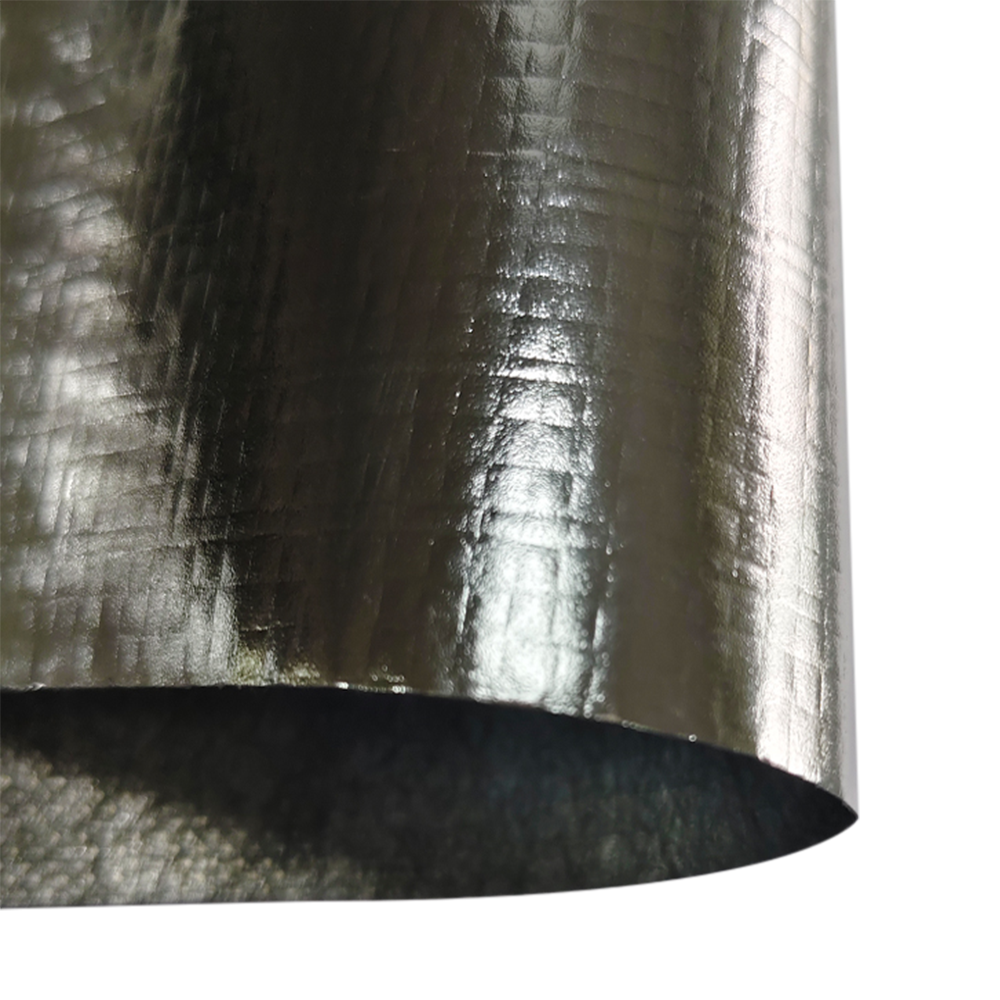 AWN140 Black Multilayer Composite Reflective FilmThree-layer aluminum film, woven and nonwoven composite for roof, wall and curtain assemblies needing heat reflection, light blocking, sound insulation and moisture resistance.View Product →
Practical questions buyers ask
Does a thicker aluminum film improve thermal performance?
Once the film is continuous and opaque, emittance matters more than thickness. Moving from a 7 micron foil to a 12 micron foil mainly improves handling and puncture resistance; it does not turn the membrane into bulk insulation. A dusty 12 micron foil can perform worse than a clean 7 micron foil because the surface emittance is higher.
Can a reflective membrane replace mineral wool or foam?
No. Reflective membranes reduce radiant transfer across air spaces; mineral wool and foam reduce conduction and convection within their thickness. In a metal building or roof, the membrane is usually part of a hybrid assembly with bulk insulation, not a substitute for it.
How should laps and penetrations be sealed?
Seal laps according to the vapour-control function, not just the reflective function. Use a compatible tape or adhesive listed by the membrane manufacturer, maintain the specified air space, and avoid compressing the membrane at purlins or framing. A taped lap that closes the cavity is no longer the tested assembly.
What test data should be requested before approval?
Request surface emittance, film type and thickness, carrier mass, tensile and tear data, water vapour transmission, and the relevant product standard. For building projects, ASTM C1224 or ASTM C1313 can define product requirements; EN 13984 applies to plastic and rubber vapour control layers. Assembly thermal claims should cite the calculation method and boundary conditions.


© 2024 Jiangsu Aotelong New Materials Co., Ltd.

-
+86-0514-87539226 (Tel)
+86-514-87539218 (Fax)
Tiancheng Road, Shatou Industrial Park, Guangling District, Yangzhou City, Jiangsu.