
 日本語
 Русский
 España
 عرب .

Multilayer Composite Reflective Film: Structure and Building Insulation Use
2026-11-13
Two rolls of reflective film can weigh the same, carry the same thickness figure and still behave differently once they are stapled between a purlin and a roof sheet. What separates them is the layer stack: which face looks into the air space, what the metallic layer is bonded to, and whether the same sheet is also doing vapour control work. This guide breaks down how a multilayer composite reflective film is built, the three heat paths it interrupts, and the specification checks that decide whether it actually performs in a roof, wall or metal building assembly.
What a Multilayer Composite Reflective Film Is
A multilayer composite reflective film is a factory-bonded sheet in which a low-emissivity metallic surface, a polymer carrier and a reinforcement layer work together to reduce radiant heat transfer across an adjacent air space. It is not bulk insulation: the film itself is a fraction of a millimetre thick, and its thermal contribution comes from surface emittance plus the air space it faces, not from the mass of the sheet.
That distinction matters at the procurement stage. A buyer who compares two films by weight per square metre is comparing the carrier, not the performance. A buyer who compares emittance, air-space geometry and vapour transmission is comparing the parts of the assembly that change the heat flow.
Reflective insulation: a sheet or multi-layer assembly with a surface emittance typically below about 0.10, installed facing one or more enclosed air spaces. Performance depends on the emittance of the surface, the thickness and sealing of the air space, and the direction of heat flow.
The Three Heat Paths It Interrupts
- Radiation. A low-emittance surface reflects long-wave infrared back towards the warm side instead of absorbing and re-radiating it.
- Conduction. The metallic layer is thin, so conduction through the film itself stays small; the carrier and any mesh add a little more.
- Convection. A narrow, enclosed air space limits air movement, and the reflective face keeps that air space from becoming a radiant bridge.
The reflective face must look into the air space. A foil laminated to a carrier and pressed tight against a solid substrate has no air space to work with, and the radiant benefit drops towards the value of the substrate beneath it.
How the Layer Stack Is Built
A typical building-grade stack runs from a reflective face, through a bonding layer, into a non-woven or woven carrier, with a mesh or scrim supplying tensile strength. Each layer has a job, and substituting one changes how the roll handles on site as much as how it performs in service.
- Reflective face. Bright aluminium foil or a metallised polymer film. This is the surface that must face the air space.
- Bonding layer. Low-density polyethylene, hot-melt adhesive or an extruded tie layer. Bond integrity decides whether the foil survives handling and stapling.
- Carrier. Polypropylene non-woven, woven polyethylene or kraft paper. The carrier gives body, tear resistance and a surface for printing or taping.
- Reinforcement. Fibreglass mesh or a woven scrim carries the tensile load across purlins and between battens.
- Functional face. Anti-condensation coating, flame-retardant treatment or a lacquered print surface, added where the assembly calls for it.
| Reflective surface | Typical emittance | Handling | Where it fits |
| Bright aluminium foil | 0.03 to 0.05 | Creases, and pinholes on sharp edges | Roof and wall air spaces, metal buildings |
| Metallised PET film | 0.05 to 0.15 | Thin, flexible, lower tear strength | Lightweight wraps and shaped sections |
| Foil on woven polyethylene | 0.03 to 0.05 | High tensile, staples without tearing | Steel frame roofs, wall wrap |
| Foil on kraft paper | 0.03 to 0.05 | Semi-rigid, accepts printing | Panels and prefabricated sections |
Metallised films are thinner and more flexible than solid foil, and the deposited aluminium layer is measured in tens of nanometres, so the emittance figure depends on coating thickness and on how the film was handled before lamination. Ask for a measured value, not a nominal one.
The Numbers That Decide Thermal Performance
Surface emittance and air-space geometry decide the thermal performance of a reflective film, and the thickness of the sheet on its own tells you very little. For an opaque surface in the far infrared, reflectance and emittance move in opposite directions, so a surface at 0.05 emittance reflects roughly 95 percent of the radiant energy that reaches it.
Test methods worth naming in a purchase order: ASTM C1371 for emittance, ASTM C518 or ASTM C1363 for assembly thermal performance, ASTM E96 or EN ISO 12572 for water vapour transmission.
Site conditions erode the number. A reflective face that collects dust, cement splash or condensation residue loses part of its low-emittance advantage, which is why the foil is normally placed facing an enclosed air space rather than an open, dusty void.
Where the Film Sits in Building Insulation Systems
Multilayer composite reflective films are used in four recurring positions: roof underlays, wall cavities, metal building roofs and walls, and retrofit linings fixed to the warm side of an existing structure. Position, not product category, determines the result.
Roof assemblies
- Under the roof sheet, foil facing down into a ventilated or sealed air space
- Over the purlin line where the film also acts as a vapour control layer
- Cold deck roofs, where the film must not trap moisture on the wrong side
Wall assemblies
- Behind cladding, with the reflective face towards the cavity
- Over sheathing, where the film doubles as a water-resistive layer
- In steel frame walls, stapled across studs with taped joints
Jiangsu Aotelong New Materials Co., Ltd. builds these films in Yangzhou, Jiangsu, and lists a reflective vapour barrier range that covers AI-film composite mesh, non-woven and woven versions, kraft-paper composite reflective film APP100, multilayer composite reflective film AWN140, non-woven composite aluminium film AN100 and reinforced aluminium film APR90. The company states that its building products are used in curtain wall, steel structure and timber frame construction.
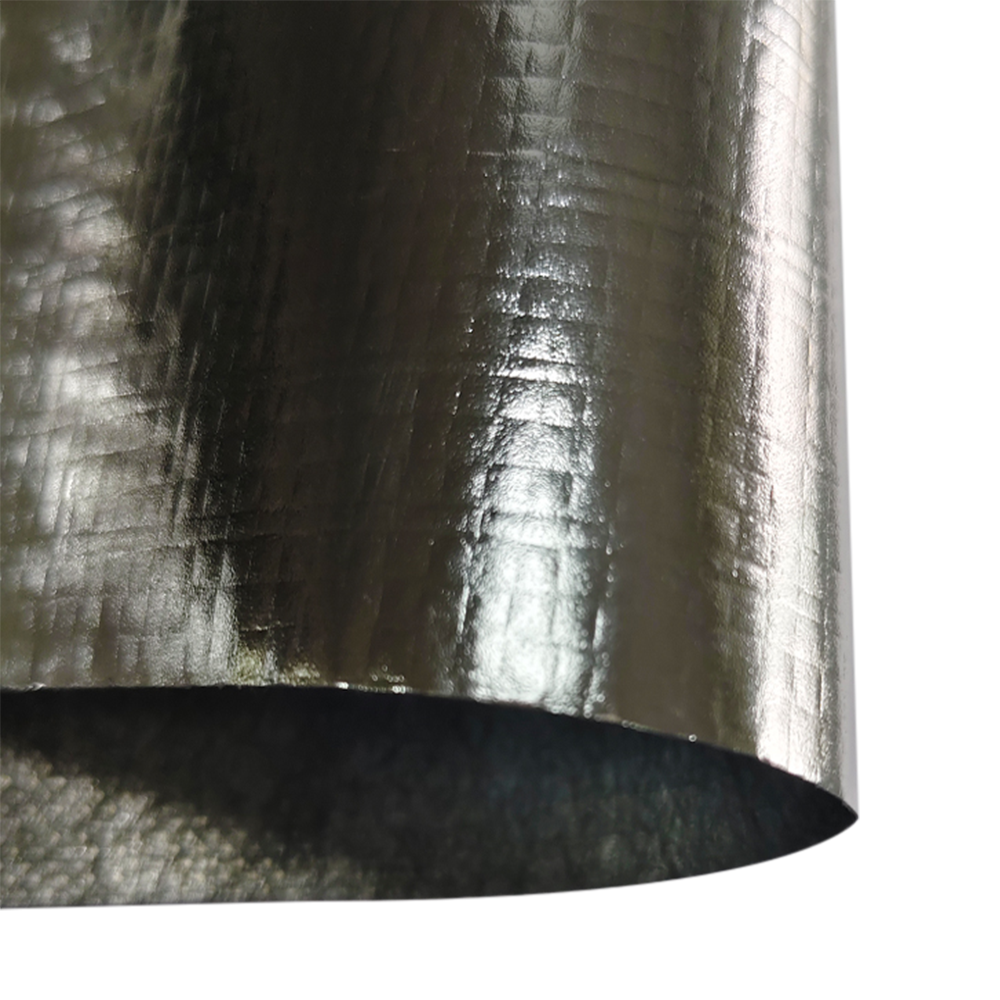 Black Multilayer Composite Reflective Film AWN140Three-layer aluminium, woven and nonwoven reflective film for roof and wall underlays; W1 water resistance and >90% solar reflectance support metal-building air-space detailing.View Product →
In metal building work, the film usually spans between purlins and creates the air space by itself. In that detail, the sag between purlins defines the air gap, so the installation tolerance is part of the thermal specification.
Vapour Control: The Failure Mode That Matters Most
A reflective film that is also vapour-tight must be the only vapour-tight layer in the assembly; two vapour barriers facing each other trap moisture between them, and the dew point lands inside the insulation. Foil-faced composites are effectively vapour-tight, so the specification question is not whether the film works but which side of the insulation it belongs on.
The double-barrier mistake. A foil-faced reflective film installed on the cold side of a wall, in front of a separate polyethylene vapour barrier, creates a sealed cavity that cannot dry inwards or outwards.
Before fixing the position, confirm the measured water vapour transmission properties to EN ISO 12572, record the declared Sd value, and check which layer the designer intends to act as the control layer.
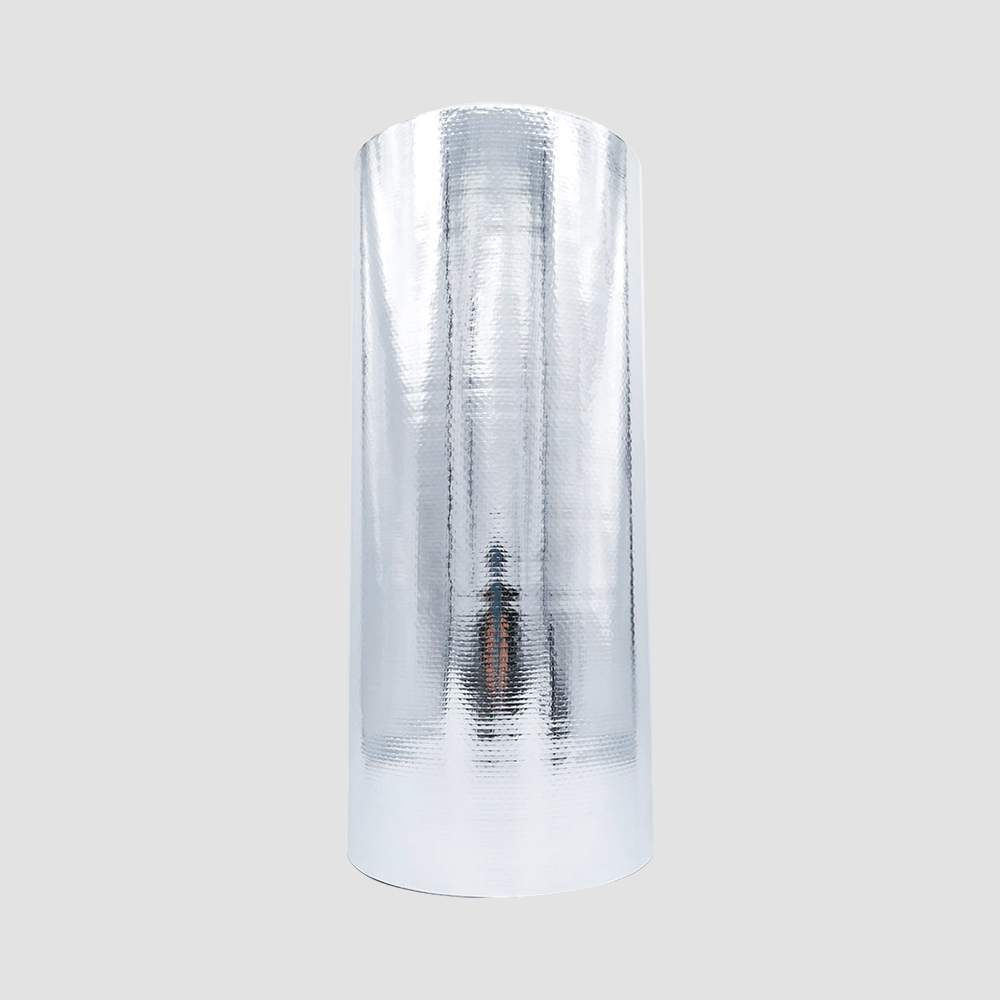 Aluminium Foil Woven Fabric Radiant Vapour BarrierMulti-layer reflective vapour-barrier membrane with woven reinforcement for roof and wall assemblies; verify its declared Sd value when choosing the control layer.View Product →
Where the design needs a diffusion-open layer rather than a barrier, a breathable membrane belongs in the assembly instead, and the reflective film moves to a position where it can still face an air space without sealing the build-up.
Specification and Purchasing Checks
Six checks separate a workable reflective film specification from a generic one: emittance test data, air space geometry, tensile and tear strength, fire classification, water vapour performance and installation detailing. Each one can be written into an enquiry without adding cost to the document.
- Emittance measured to ASTM C1371 on the delivered construction, not inherited from a foil supplier
- Air space width and whether it is ventilated or sealed, stated on the drawing
- Tensile and tear strength against the purlin spacing and the wind load case
- Fire classification to EN 13501-1 or surface burning data to ASTM E84
- Water vapour transmission to EN ISO 12572, with the Sd value recorded
- Tape, lap and penetration detailing, plus the window tape grade for the joint
On the factory side, certification claims are worth verifying rather than repeating. Jiangsu Aotelong states that it has passed ICC-ES and BBA factory inspections, that its polypropylene spunbond and waterproof breathable membrane products were tested by the China National Building Material Test Centre, and that the same products carry CE marking and BBA certification. Buyers working through the wider envelope should also read a practical overview of the different types of waterproofing in construction, because reflective films are frequently specified alongside, and sometimes instead of, conventional waterproofing layers.
 Heat-Resistant Reflective Vapour Barrier APR90 / HRV-90PET-mesh reinforced reflective vapour barrier for pitched roofs, walls and floors; use it with bulk insulation to address radiant transfer and condensation control.View Product →
Does a reflective film replace mineral wool or foam?
No. A multilayer composite reflective film controls radiant transfer across an air space and is normally used together with bulk insulation, not instead of it. In a metal building roof, the film handles the radiant component and the condensation control while the bulk layer handles conduction.
Which side of the air space should the foil face?
The low-emittance face should look into the enclosed air space, with at least 20 mm of clear gap commonly specified for the space to stay still. Foil pressed against a solid surface performs close to that surface, so the air space is a design element rather than a leftover gap.
Can a foil-faced film be used in a heating-dominated climate wall?
Yes, provided it is placed on the warm side and remains the only vapour-tight layer. Where the wall already contains a polyethylene vapour barrier, the reflective film must move, be perforated, or be replaced by a diffusion-open membrane to avoid trapping moisture inside the insulation.
How do you verify an emittance claim before ordering?
Request test data to ASTM C1371 for the finished composite, not for the raw foil, and confirm the measurement was taken on the face that will look into the air space. Emittance between 0.03 and 0.05 is the normal band for bright aluminium foil; values above 0.10 point to a metallised film or a coated surface.
Treat the reflective film as one layer in a drying strategy, not as a standalone product. Emittance, air space and vapour position decide the outcome, and all three are settled on the drawing before a single roll is ordered.


© 2024 Jiangsu Aotelong New Materials Co., Ltd.

-
+86-0514-87539226 (Tel)
+86-514-87539218 (Fax)
Tiancheng Road, Shatou Industrial Park, Guangling District, Yangzhou City, Jiangsu.